ÄRNI BLUM: Timeless, Characterful Knitwear Made with Heart

ÄRNI BLUM: Timeless, Characterful Knitwear Made with Heart

09.09.2026

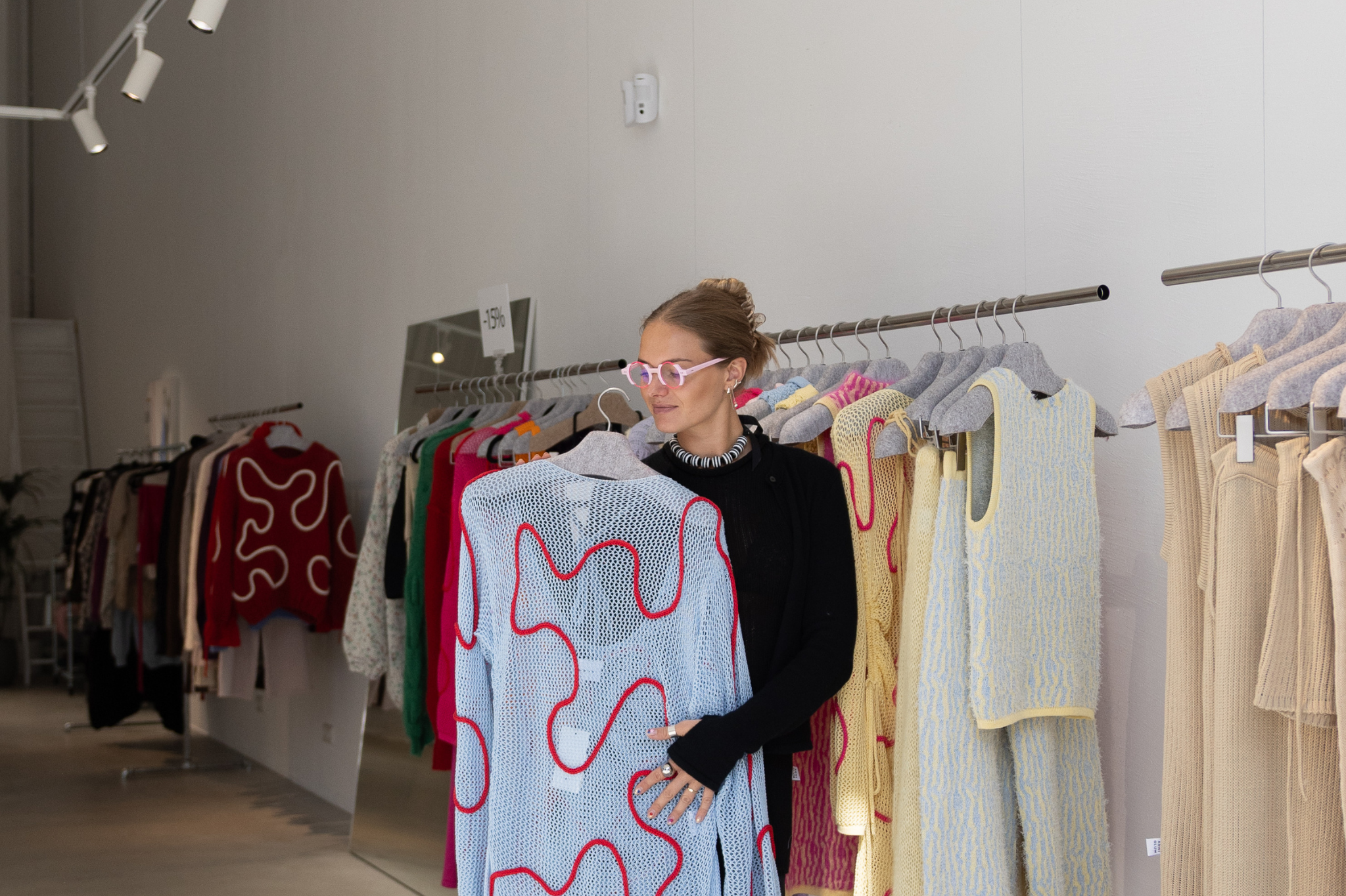
In this edition of the Artist Series, we step into the world of Johanna Paiste, the designer behind ÄRNI BLUM. We visit her sewing atelier in Kuressaare, where ÄRNI BLUM garments are brought to life, as well as the studio shop in Telliskivi Creative City, which has become a meeting place for knitwear enthusiasts and design lovers. We talk about how a hobby of knitting grew into a business, and about Johanna’s dreams, challenges and joys as she leads her brand.

How and when did you decide to create your own brand, and why knitwear rather than, for example, textile art or fashion design?

I have been knitting my whole life, largely inspired by my mother, who is a hobby knitter. I have always been fascinated by knitwear in particular – its texture, form and possibilities. At the same time, I never consciously dreamed of becoming a knitwear designer. However, I have always been drawn to fashion and beautiful objects.

At some point, I started selling my knitwear to friends, then friends of friends, and eventually to complete strangers. Encouraged by them, I created the Nirgiwabrik Instagram account in 2017. For the first three years, I treated it as a hobby while working at a beauty salon.

When my second daughter was born, I realised that my hobby had grown into something much more. I decided not to stop, but to develop it further. That was when the first knitters from Saaremaa joined me, I found my first retailers, and the snowball started rolling.

Why is it important to you to produce your products specifically in Saaremaa?

Both my husband’s and my roots are in Saaremaa, and much of our lives have been connected to this place. As the company grew, it felt natural that production should remain here as well.

I am very grateful to be able to work with knitters who have decades of experience behind them. Their skills and dedication are an important part of ÄRNI BLUM’s quality. For me, local production also means an opportunity to keep the tradition of craftsmanship alive and provide work for people in my community.

When and why did you decide to rebrand from Nirgiwabrik to ÄRNI BLUM, and how did the new name come about?

The name Nirgiwabrik came about quite spontaneously. Nirk was my maiden name, and because I was knitting like a little factory, it seemed fitting at the time.

Over the years, however, the brand evolved along with me. When I started creating complete collections, I felt that the name no longer conveyed the quality and aesthetic I was striving for.

The rebranding took nearly ten months. I tried hundreds of different names until, at one point, I remembered my grandfather’s birth name, Ärni Blum. From that moment on, everything felt right, and I have never regretted the decision.

What kind of change did the name change bring to your brand?

It is difficult to say how much of the change was specifically due to the name, because many important things were happening at the same time. During the rebranding, in the summer of 2023, I took part in the Estonian Fashion Festival, where I presented my collection under the ÄRNI BLUM name for the first time. That was where Aldo Järvsoo noticed me, and through him I was invited to Tallinn Fashion Week that autumn. Soon afterwards, Kaubamaja also got in touch with the wish to start selling ÄRNI BLUM products.

All these events happened during the same period, and it felt as though the brand had reached the next level at exactly the right moment. I have received a lot of feedback that the new name feels more mature and luxurious, and reflects better what ÄRNI BLUM has become. Of course, there are people who remember Nirgiwabrik with warm nostalgia, but I feel that changing the name was one of the best decisions I have made for the brand.

How would you define the ÄRNI BLUM aesthetic?

At the heart of ÄRNI BLUM are texture, softness and individuality. I love monochromatic tones, sculptural shapes and soft materials.

I want to create garments that stand the test of time and can be styled in many different ways. Each piece should have an unexpected detail that makes it special.

What materials do you mainly use?

Material is one of the most important parts of design for me. A good cut cannot save a product if the material is not high quality. Very often, a new idea starts with the yarn itself – its texture, feel and character.

One of my absolute favourites is Japanese silk mohair, whose soft and airy texture has become one of ÄRNI BLUM’s signature characteristics. In the main collection, I primarily use certified natural materials such as wool and cotton, and I prefer pure mono-materials whenever possible.

At the same time, I also enjoy experimenting with materials. For example, I have created special pieces by combining organic cotton with elastic fibres to achieve a completely new texture. For fashion collections, I also often use leftover materials and unused yarns, giving them a new life. This allows me to combine creativity with a more conscious approach to materials.

How would you describe the process of creating a knitwear piece — from the initial idea to the finished product?

It usually all starts with a feeling or a vision. I am inspired by textures, shapes and materials. Often, the idea begins with a silhouette or surface, and only then do I start looking for the yarn that will bring it to life most successfully. I make swatches, test different solutions, develop prototypes, experiment with the cut, wash and test them.

Creating knitwear differs significantly from conventional fashion design because we do not cut pieces from pre-made fabric. Every detail is knitted to the correct measurements from the outset, which means calculating stitches, rows and dimensions. The first version often needs adjustments, and it is only the second or third prototype that eventually goes into production.

Yarn is an integral part of the design for me. You cannot simply remake the same model in a different material, because every yarn behaves differently and changes both the shape and the overall character. Using a new material essentially means developing a new product.

Although we work to order and adapt designs according to customers’ wishes, every change requires careful consideration. That is what makes knitwear design so fascinating – and also considerably more complex than it may seem at first glance.

What is most important to you in your work?

The most important thing for me is the opportunity to create. The design process and knitting give me the most energy, and they are the reasons I embarked on this journey in the first place.

Today, however, as the head of a small business, I am often more of an entrepreneur than a designer. A large part of my time goes into management, planning and solving everyday problems. My goal is to grow the company step by step so that, in the future, I can focus more on what I love most – creativity.

What would help solve this problem?

Over the past year, we have grown our team, and today we have both an administrator and new knitters. This has helped me focus more on what is most important in my role.

Right now, the goal is no longer simply to grow, but to find a stable rhythm. I want the company to operate sustainably, with a balanced day-to-day workload and enough space left for creativity and developing new ideas.

Where do you find inspiration?

The best ideas come when I slow down. Travelling, being in a new environment or simply having a moment to myself creates space to notice things and create. When your days are spent entirely solving problems, there is too little room for creativity.

What is your favourite product at the moment?

Usually, the piece that is closest to my heart is the one I have created most recently. There is always a little honeymoon phase with new designs, and I find myself wearing them again and again.

If I had to choose one favourite, though, it would definitely be the Roots Top. It is one of those pieces that gets the most wear in my wardrobe. I love its versatility – during colder weather I wear it over a shirt or T-shirt, while in summer I wear it as a standalone top. It can be styled both casually and more formally, and those are exactly the kinds of garments I like to create.

How much attention do you pay to trends, and do you follow them?

I certainly keep an eye on the fashion world, but I never design based solely on trends. Of course, our surroundings influence all of us to some extent, but my goal is to create garments that stand the test of time and do not lose their value after a single season.

Trends influence me more through colour choices and styling than through cuts or design. I want every ÄRNI BLUM piece to be high quality, versatile and wearable years from now. For me, the most important thing is to create something a person will want to wear not only today, but five or ten years from now as well.

How do you stay motivated when things get difficult and there is a lot of work?

Entrepreneurship inevitably comes with more challenging periods. I like to joke that “I didn’t want to work nine to five, so I became an entrepreneur – now I work 24/7,” but there is some truth to it.

I have learned that when you feel you cannot keep going, you need to take a moment for yourself. Often, just a couple of days away from work is enough. That is when new ideas tend to return, and I remember why I am doing all of this.

The greatest motivation, however, comes from the fact that ÄRNI BLUM grew out of my biggest hobby. I have the privilege of doing work that I genuinely love, and that gives me the strength to keep moving forward even during difficult times.

What do you consider your greatest achievement so far?

My greatest achievement is that I have managed to turn a hobby into a business. Sometimes I have to remind myself that it is no longer a dream, but actually my job.

What gives me the most energy is knowing that I get to do what I love, and that there are people who want to wear the knitwear I create.

You were also nominated for the Hõbenõel award. What did that recognition mean to you?

For me, it was above all a confirmation. When you are immersed in your work every day, it is easy to forget just how far you have actually come.

The thought that a hobby of knitting grew into a brand that received a Hõbenõel nomination still makes me very grateful. Recognition like this is not only about being noticed; it also gives you confidence that what you are creating resonates with people. And that, in turn, is the greatest motivation to keep moving forward.

Where is Estonian design heading?

It seems to me that Estonian design is moving increasingly towards more conscious consumption and more individual forms of self-expression. People are placing greater value on quality, local makers and garments that have a story of their own.

At the same time, fashion is becoming more relaxed. People are more willing to play with shapes, textures and layers and to develop their own personal aesthetic. I believe this diversity is precisely what makes Estonian design strong and helps it stand out increasingly on the international stage.

Where do you see ÄRNI BLUM five years from now?

In January, one of my biggest dreams came true when I opened my studio shop in Telliskivi Creative City. I hope it will become a meeting place for both knitwear enthusiasts and design lovers – a place where new ideas are born, workshops take place and people can get to know the world of ÄRNI BLUM more closely.

Over the next five years, I want to grow ÄRNI BLUM internationally as well. At the same time, it is most important to me that the company grows sustainably. I do not feel that I necessarily need to reach the masses; rather, I want to create something that lasts.

My goal is to build a company where both my team and I enjoy working. I want to have increasingly more time for creativity and for ÄRNI BLUM to develop at its own pace, while preserving what has been most important to me from the very beginning: quality, thoughtful creation and the joy of making.

Is there anything else you would like to talk about?

One topic I always want to remind people about is knitwear care. Knitwear is often treated like any other garment, but in reality it requires a slightly different approach.

Wool is naturally a self-cleaning material, so in most cases a knitted garment does not need to be washed after every wear. Often, simply airing it out or spot-cleaning it when necessary is enough. The less you wash a knitted garment, the longer it will retain its beauty and properties.

It is also often assumed that pilling means poor quality, but that is not true. Even high-quality natural fibres can pill as a result of friction. It is a natural characteristic of the material, and with the right care techniques, it is easy to restore the garment’s beautiful appearance.

For me, it is important that people know how to appreciate their knitwear and take care of it properly. A well-cared-for knitted garment can bring joy to its wearer for many years.


Interview: Margaret Aidla

Photos: Sirje Sinisoo, Karmen Alamets